Stop Direct Compression Failures by Balancing MCC Lactose and MgSt
Direct compression formulation is a precise balancing act. Success often relies on the excipient "triangle": microcrystalline cellulose (MCC) for mechanical strength, lactose for solubility and mouthfeel, and magnesium stearate for essential lubrication. This guide provides a compact, field-tested framework we use when supporting customers who source high-quality excipients from Shandong Shine Health, helping you navigate the trade-offs between hardness, disintegration, and dissolution.
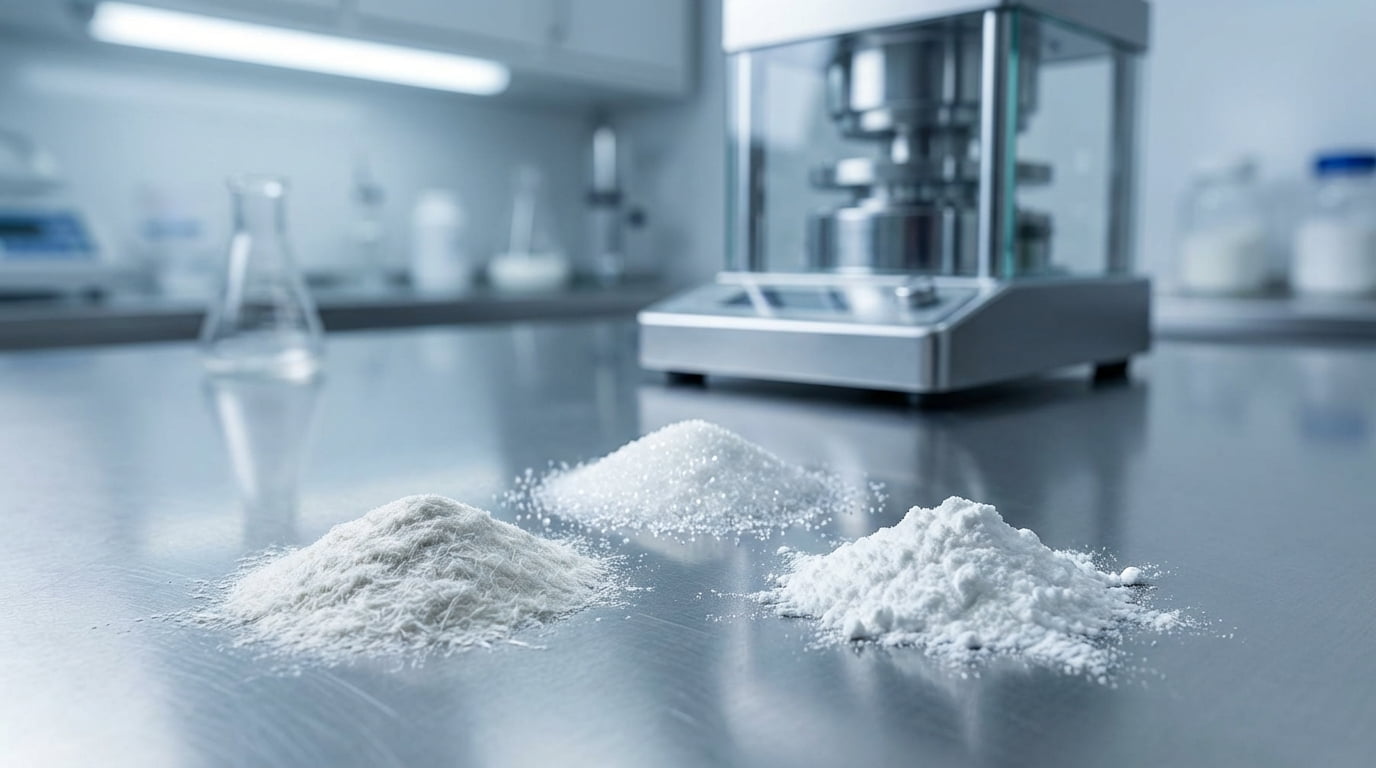
MCC, Lactose, and MgSt at a Glance
Understanding the distinct roles of each component is the first step toward a robust formulation. The table below outlines how these materials interact under pressure.
| What you optimize | MCC (PH grades) typically does | Lactose typically does | Where magnesium stearate matters most |
|---|---|---|---|
| Tabletability (strength at pressure) | Plastic deformation → strong inter-particle bonds | Brittle fragmentation → workable strength, often needs support | Too much coating reduces bonding, so strength drops |
| Disintegration | Can be slower if the whole system is insoluble | Dissolves quickly → opens pores and speeds breakup | Hydrophobic film can slow wetting and delay disintegration |
| Mouthfeel / palatability | Neutral, sometimes slightly fibrous | Smooth, slightly sweet | Excess lubricant can create a “waxy” feel in chewables |
| Process robustness | Helps reduce capping/lamination at short dwell time | Good filler; supports fast breakdown | Mixing time and order define risk more than the label says |

Practical rule: Start with MCC for mechanics, add lactose for speed and taste, then treat magnesium stearate as a controlled variable, not a fixed checkbox.
1) Build Tablet Strength with Microcrystalline Cellulose
Microcrystalline cellulose serves as the backbone for many direct compression blends because it compacts efficiently and tolerates high-speed compression well. In our experience with troubleshooting customer formulations, adjusting the MCC grade or ratio is often the fastest way to raise tensile strength without adding a separate binder.
How we typically start with MCC:
- Baseline: Use general-purpose grades such as PH-101 or PH-102.
- Flow vs. Strength: If flow into a rotary press becomes the bottleneck, consider coarser MCC options; if strength is the bottleneck, consider finer MCC options.
- Dwell Time: When dwell time is short, increasing the MCC fraction is a reliable move to reduce capping risk.
2) Use Lactose to Speed Disintegration and Improve Mouthfeel
Lactose brings what MCC does not: high solubility, a smoother bite, and a cleaner, less fibrous sensation. This is especially helpful in nutraceutical tablets and consumer-facing formats where texture matters.
A common, low-risk adjustment is swapping 10–20% of the MCC portion to lactose. Many teams see a clear drop in disintegration time without destabilizing compression—provided magnesium stearate is controlled properly.
Trade-off to plan for: Lactose-rich blends can lose hardness at the same compression force compared to pure MCC tablets. The usual fixes are simple and incremental: slightly higher compression force, a modest MCC increase, or using a co-processed MCC–lactose approach.
3) Magnesium Stearate: Protect Throughput, Watch Dissolution
Magnesium stearate is cost-effective and highly efficient, but it is also the most common reason a “good” tablet fails disintegration or dissolution testing after scale-up.
What typically goes wrong isn’t only the percentage—it’s the film formation caused by late-stage overmixing. A fine, hydrophobic coating reduces die-wall friction (good) but also reduces inter-particle bonding and water wetting (bad).
Control plan we recommend:
- Start low: 0.25–0.5% w/w magnesium stearate for screening.
- Add last: Only introduce it after the MCC, lactose, and actives are uniform.
- Blend briefly and reproducibly: Lock time and speed (for many mixers, 30–120 seconds is the right testing window).
- Confirm with a small QC panel every time you change mixing time:
- Hardness / tensile strength
- Friability (often target ≤ 1%)
- Disintegration
- Dissolution profile in the target medium
If magnesium stearate must stay low and sticking still appears, it can be worth screening alternatives such as sodium stearyl fumarate—but any lubricant change must be re-qualified against dissolution standards.
4) Enhancing Formulations with Resistant Dextrin
When customers want added fiber positioning in nutraceutical tablets, resistant dextrin can be introduced into an MCC–lactose base, while still keeping direct compression practical.
Our resistant dextrin is positioned as a soluble dietary fiber derived from non-GMO corn starch, boasting a fiber content ≥82% and low protein content (≤6.0%). It is produced on a German-origin precision line utilizing Japanese process expertise, ensuring high consistency for sensitive formulations.
A Simple Optimization Workflow
- Choose MCC grade: PH-101/PH-102 as default.
- Set lactose level based on the performance priority:
- 0–20% lactose: Max strength.
- 20–40% lactose: Balanced IR tablets.
- 40–70% lactose: Faster disintegration, improved mouthfeel.
- Add resistant dextrin at moderate proportions when fiber is a label requirement.
- Then tune magnesium stearate (level + mixing time) only after the blend is stable.
5) Supply and Technical Support from Shine Health
We manufacture and supply microcrystalline cellulose, lactose, magnesium stearate, and resistant dextrin, supported by GMP-style workshops, ISO-based quality systems, COA support, and full batch traceability. Our facilities utilize fully automatic unmanned production lines to minimize human error and ensure purity.
For direct compression projects, our technical team is available to help you define a starting MCC–lactose ratio and a magnesium stearate control window that protects both compression efficiency and dissolution profiles.

FAQs About Excipient Selection
Q: How does MCC grade affect tablet hardness?
A: Finer grades of MCC typically offer more surface area for bonding, increasing tablet hardness, while coarser grades improve flow properties for high-speed presses.
Q: Can I replace Lactose Monohydrate with Anhydrous Lactose?
A: They have different compaction properties. Anhydrous lactose is generally better for direct compression due to its brittle fracture mechanism, whereas monohydrate is often used in wet granulation.
Q: Does Shine Health offer custom excipient blends?
A: Yes, we offer ODM services and can assist in tailoring excipient specifications to meet your unique formulation requirements.
Contact Us
Ready to optimize your formulation? Request samples or formulation support via WhatsApp or email us directly at info@sdshinehealth.com.
Related Products
Data Sources
- van Kamp, H. V., Bolhuis, G. K., & Lerk, C. F. (1987). Optimization of a formulation for direct compression using a simplex lattice design. Pharmaceutisch Weekblad. https://doi.org/10.1007/BF01953629
- Dominik, M., Vraníková, B., Svačinová, P., et al. (2021). Comparison of flow and compression properties of lactose-based co-processed excipients. Pharmaceutics, 13(9), 1486. https://doi.org/10.3390/pharmaceutics13091486
- Verónica, N., Heng, P. W. S., & Liew, C. V. (2024). Magnesium stearate fatty acid composition, lubrication performance and tablet properties. AAPS PharmSciTech. https://doi.org/10.1208/s12249-024-02980-x
- Ng, J. A. S. (2020). Evaluation of microcrystalline cellulose as a disintegrant in tablet formulations. Advanced Pharmaceutical Bulletin. https://doi.org/10.34172/apb.2020.050