Why MCC Grade Details Beat Price Quotes Every Time
For buyers sourcing microcrystalline cellulose from China, the first email often asks for a unit price. In practice, that question usually comes too early. Microcrystalline cellulose is purchased across pharmaceuticals, nutraceuticals, food, cosmetics, and industrial uses, and a quote only becomes comparable after both sides align on the same grade and specification.
A specification-first sequence is typically the fastest way to avoid rework: application → grade and target specification → sample → commercial quotation. This is why a clear MCC grade guide often improves supplier conversations more than a quick price list.

Why grade and specs should come before price
When teams treat microcrystalline cellulose as a simple commodity, they risk comparing offers that are not technically equivalent. Many procurement delays come from small gaps in the early briefing: the end-use differs, the required standard differs, or packaging expectations differ.
A practical way to keep the discussion technical—without making it overly complicated—is to anchor the conversation on:
- Intended use (tablet, capsule, food, cosmetics, or other)
- Grade naming and coverage (what PH grades are actually available)
- Applicable standard (BP / USP / FCC / JP)
- Purchasing format (bulk packaging and whether customization is needed)
- Sample availability (so you can evaluate fit before scale)
What a supplier grade guide looks like in real procurement
On its product pages, Shine Health (Shandong Shenghuai Health Co., Ltd.; Shine Health) publishes a grade range and a core parameter set that buyers can use as a starting point for technical alignment. The listed microcrystalline cellulose range includes PH-101, PH-102, PH-103, PH-105, PH-112, PH-113, PH-200, PH-301, and PH-302, with a mesh range of 60–200, purity 0.99, and CAS 9004-34-6.
For buyers who want to start with an official product listing, the page for microcrystalline cellulose bulk presents the portfolio-level overview. The same specification set also highlights BP/USP/FCC/JP standards, samples freely offered, and packaging noted as 20KGS/woven bag, with customization described as available.
The procurement takeaway is simple: if your team needs a specific microcrystalline cellulose grade behavior in processing, request the grade-specific sheet and confirm the target standard and packaging before asking for final pricing.
| Published grade range | PH-101, PH-102, PH-103, PH-105, PH-112, PH-113, PH-200, PH-301, PH-302 |
|---|---|
| Standards shown | BP / USP / FCC / JP |
| Mesh range | 60–200 |
| Packaging example | 20KGS/woven bag with customization available |
Matching MCC to the application you are building
Shine Health describes microcrystalline cellulose as a white, odorless, and tasteless powder derived from refined wood pulp, and positions it as a versatile excipient used across multiple industries. The site describes common roles in tablets and capsules, plus stabilizing and texture-related uses in food and cosmetics.
To help internal stakeholders align—R&D, QA, and sourcing—it can help to document the application context in plain language: what you are making, how you will process it, and what your acceptance checks are. That short brief is often enough for a supplier to confirm whether a given PH grade is appropriate, or whether a different grade in the same microcrystalline cellulose family should be evaluated first.
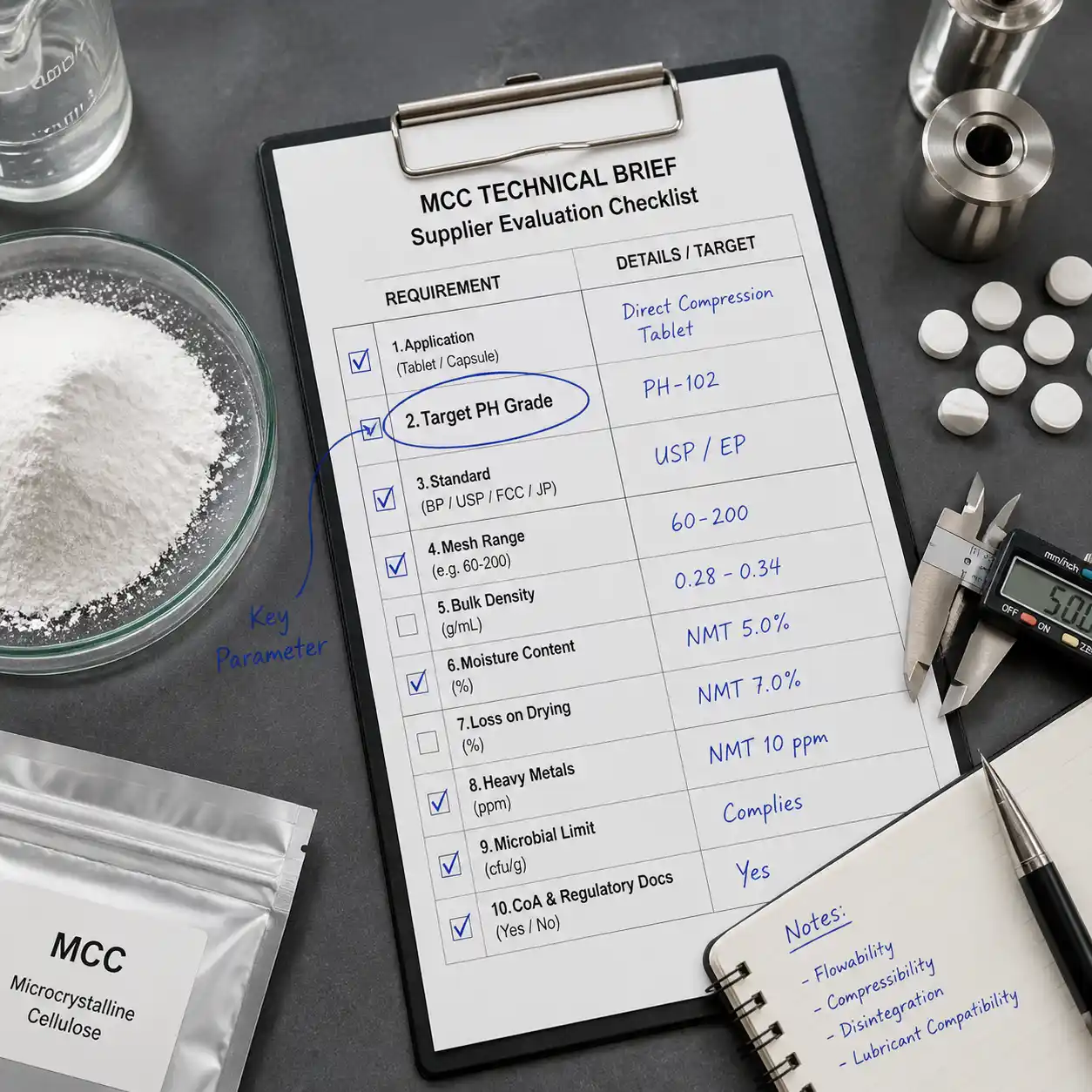
A simple briefing checklist for Chinese MCC suppliers
A first inquiry works best when it reads like a technical purchasing brief. For microcrystalline cellulose, consider including the following items in the first message:
- Application (tablet, capsule, food, cosmetics, or industrial use)
- Target PH grade (if already selected)
- Target mesh range (or confirm that the supplier’s 60–200 mesh range is acceptable)
- Required standard (BP / USP / FCC / JP)
- Required purity level (if you follow a defined internal spec)
- Order quantity and target delivery plan
- Packaging format (e.g., 20 kg woven bag, and whether customization is needed)
- Request a sample for evaluation before the commercial quote is finalized
This structure reduces the chance that two quotations are actually for different specifications, even though both are labeled microcrystalline cellulose.
Quality, manufacturing, and packaging checkpoints buyers can ask about
Supplier pages from Shine Health emphasize batch testing, and describe that particle size, density, moisture, specifications, and packaging can be adjusted to customer requirements. The published specification table also lists HPLC Test as the test method and notes certifications including ISO9001/Kosher/Halal.
Operationally, buyers often like to see a real production environment when evaluating any microcrystalline cellulose supplier for long-term supply. Shine Health provides factory visuals on its product pages, which can be useful during early due diligence discussions.
One supplier conversation can cover more than MCC
For teams consolidating excipients and functional ingredients, Shine Health also lists Resistant Maltodextrin and Indigestible Maltodextrin in its portfolio. As with microcrystalline cellulose, these materials should be discussed with their own specifications rather than assumed to match MCC parameters.
When an MCC quotation becomes truly comparable
A quotation becomes meaningful when the buyer’s application, the PH grade, the BP/USP/FCC/JP standard, and the packaging format are aligned—and a sample has been evaluated against your process needs. At that point, price comparisons across a Chinese microcrystalline cellulose supplier shortlist are based on the same technical target, not on assumptions.
For grade coverage, specifications, or samples, visit www.sdshinehealth.com or email info@sdshinehealth.com.
FAQs
Which microcrystalline cellulose grades are listed by Shine Health?
PH-101, PH-102, PH-103, PH-105, PH-112, PH-113, PH-200, PH-301, and PH-302 are listed on the Shine Health product pages.
What standards are shown for Shine Health microcrystalline cellulose?
The product specification table lists BP/USP/FCC/JP.
What mesh range does Shine Health publish for microcrystalline cellulose?
The published mesh range is 60–200.
What packaging is listed for microcrystalline cellulose bulk?
The specification table lists 20KGS/woven bag and notes customization according to customer requirements.
Are samples available before bulk purchasing?
Yes. The specification table states that samples are freely offered.
What is the simplest way to start a supplier conversation?
Share your application first, then the target PH grade (if known), the required BP/USP/FCC/JP standard, your mesh/spec expectations, packaging format, and the quantity—then request a sample before the final quote.
References
- Chaerunisa, A. Y., Sriwidodo, & Abdassah, M. (2019). Microcrystalline cellulose as pharmaceutical excipient. IntechOpen. https://doi.org/10.5772/INTECHOPEN.88092
- Thoorens, G., Krier, F., Leclercq, B., Carlin, B., & Evrard, B. (n.d.). Microcrystalline cellulose, a direct compression binder in a quality by design environment—A review. http://www.phexcom.com/UploadFiles/%E8%8B%B1%E6%96%87-FMC-Microcrystalline%20cellulose%20a%20direct%20compression%20binder%20in%20a%20quality%20by%20design%20environment.pdf
- Lamkane, V., Mote, U., Wankhede, K., & Kakde, P. (2023). Pharmaceutical excipients in the paediatric formulation. IJFMR. https://doi.org/10.36948/ijfmr.2023.v05i06.8376