Stop Trusting Resistant Dextrin Suppliers Who Only Win on Price
Selecting a resistant dextrin supplier in China based solely on the lowest quote and a pristine 1 kg sample is practically an invitation for quality and brand risks. Many buyers find out the hard way that bulk deliveries rarely match the initial sample in fiber content, microbiological stability, or documentation traceability. By the time these issues surface, reformulation delays, product recalls, and reputational damage are already threatening the business.
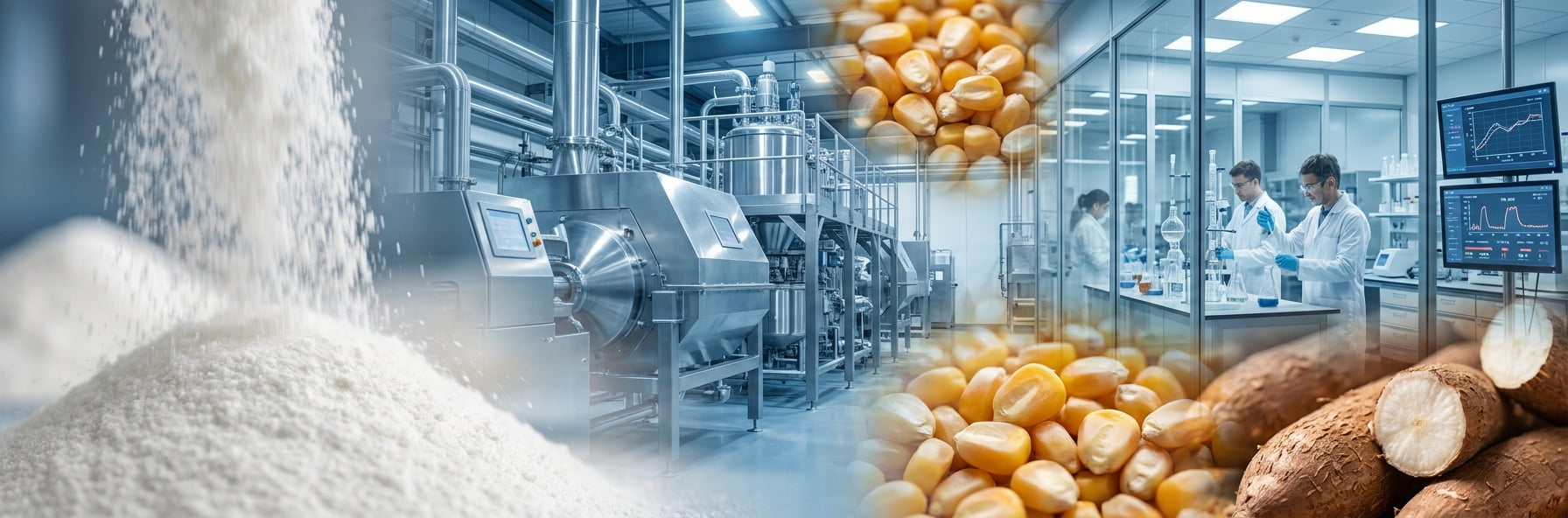
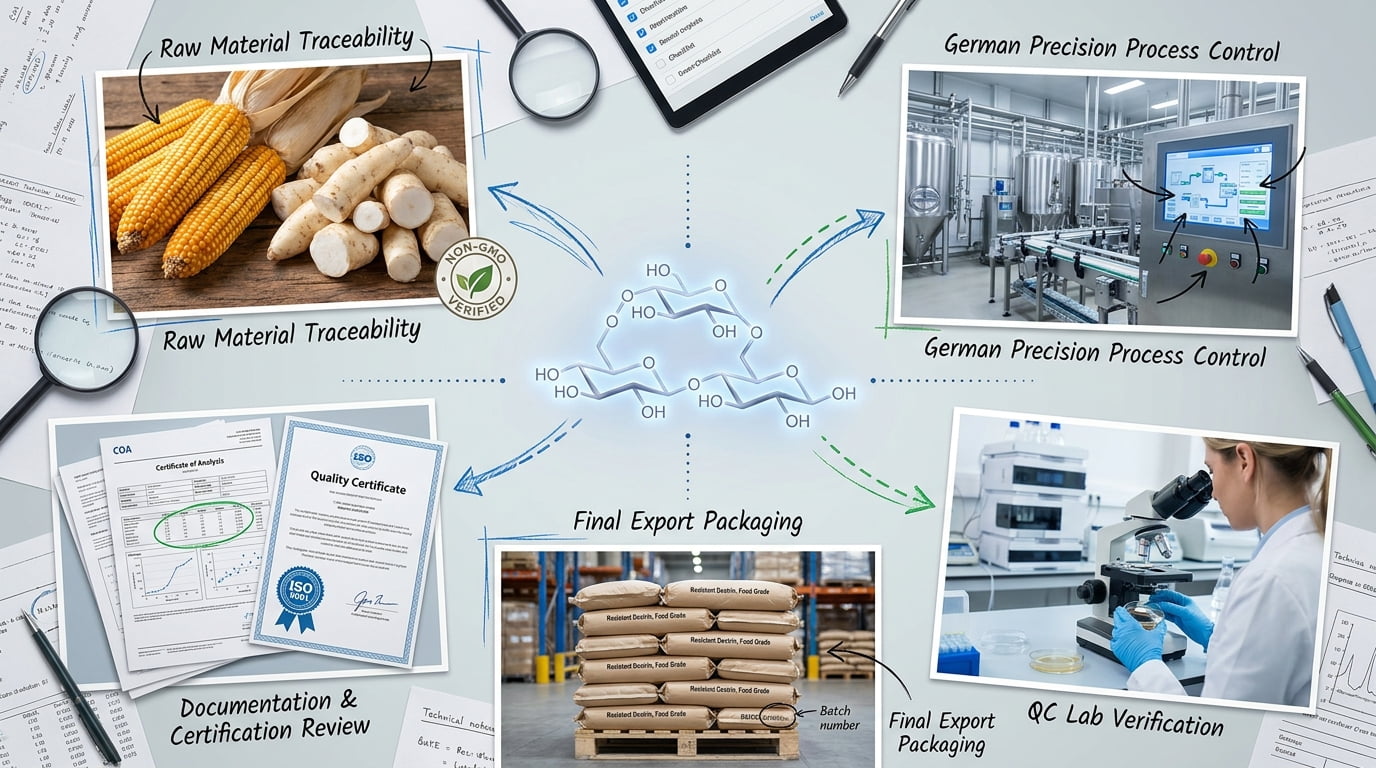
Behind every stable non-GMO resistant dextrin, there must be a comprehensive, full-chain quality system. This involves everything from sourcing NON-GMO corn or tapioca starch to utilizing imported enzymes on a precision production line, right down to finished product testing and secure export packaging. Drawing on openly published industry standards from established manufacturers, this guide outlines exactly what you should expect from any resistant dextrin supplier in China before giving them your approval.
Why Price and a 1 kg Sample Are Never Enough
A small 1 kg bag merely proves that a single micro-batch was manufactured correctly. It actually tells you very little about the broader operational realities:
- Whether every batch of NON-GMO corn starch or tapioca starch entering the factory meets strict quality standards.
- How consistent the automated precision production line remains over months of continuous operation.
- Whether the in-house QC laboratory genuinely tests each lot for critical metrics like fiber content, moisture, water activity, and microbiological limits before shipping.
If you greenlight a China soluble fiber manufacturer based only on a cheap price and a single Certificate of Analysis (COA), you are accepting the gamble that subsequent batches might:
- Fluctuate wildly, dropping from the expected ≥82–95% dietary fiber down to unacceptable levels.
- Fail microbiological safety limits, such as an aerobic plate count exceeding 1000 CFU/g or Coliforms above 3 MPN/g.
- Arrive with fragmented documentation, leaving you vulnerable when regulators or your own customers demand traceability.
To avoid the classic "the sample is great, but the bulk is a surprise" scenario, procurement teams must evaluate the entire quality control system rather than just looking at the final powder.
What a Complete Resistant Dextrin Quality System Should Cover
By examining the public product pages of mature Shandong resistant dextrin manufacturers, we get a transparent look at how proper quality control is structured. You can leverage this exact framework to benchmark any prospective resistant dextrin supplier in China.
1. Raw Material Sourcing and Traceability
Industry leaders clearly state that their resistant dextrin and related soluble dietary fibers are derived from high-purity NON-GMO corn starch or tapioca starch, typically sourced from top-tier producers. This forms the absolute bedrock of any credible non-GMO resistant dextrin claim.
When auditing a new supplier, ask them to provide documentation comparable to what premium manufacturers offer:
- A definitive statement clarifying whether they use NON-GMO corn starch or tapioca starch.
- Traceability records covering the seeds, origin, harvest lots, and upstream starch vendors.
- Incoming inspection logs for each starch delivery (checking appearance, moisture, and basic safety).
- Raw-material COAs that seamlessly link to the finished product COAs.
Any resistant dextrin supplier in China that fails to produce this basic paper trail will inevitably struggle to support your clean-label, non-GMO, or organic marketing efforts down the line.
2. Enzymes, Process Control, and Production Lines
High-grade production usually involves a combination of advanced biological enzymes imported from overseas, precision production lines (often of German origin), and fully automated central control systems.
Process diagrams from leading facilities illustrate a clear pathway from starch feeding and enzymatic conversion through to purification, drying, and automatic packaging. When visiting or remotely auditing a non-GMO resistant dextrin plant in China, you should request:
- Details on their enzyme suppliers along with batch tracking records.
- A comprehensive list of major equipment on their precision line, noting models and origins.
- An up-to-date production flow chart that corresponds with what is actually on the factory floor.
- Batch records showing critical parameters like pH, temperature, and reaction times.
- Calibration and maintenance logs for key processing equipment.
A genuine automated line leaves a highly visible data trail. If a supplier boasts about "advanced technology" but cannot provide concrete equipment lists or operational records, consider that a major red flag.
3. Production Workshop Hygiene and In-House QC Laboratory
Top-tier suppliers frequently showcase their modern production workshops, highlighting operations under GMP-standard and HACCP-compliant conditions, supported by a fully equipped QC laboratory.
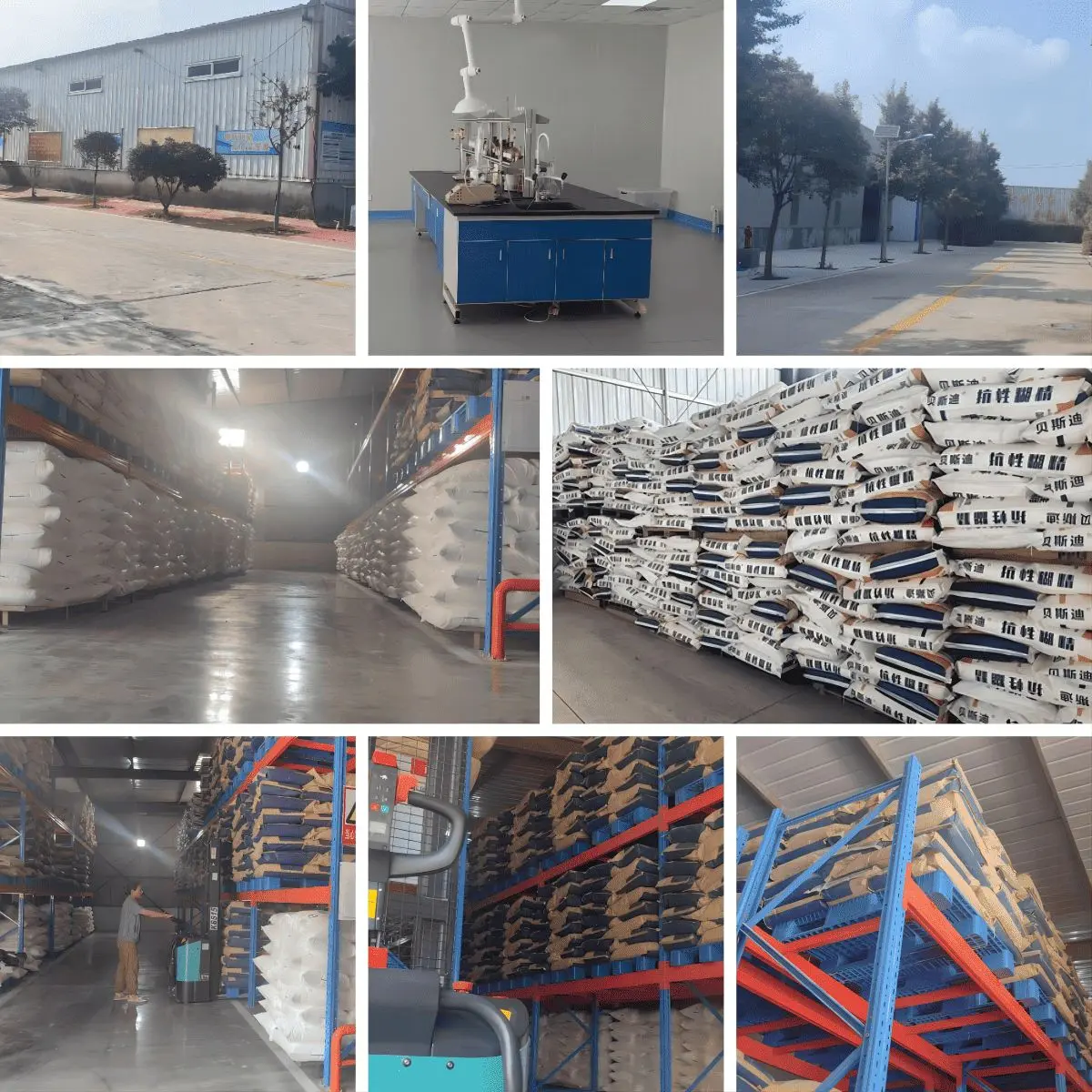
Reliable manufacturers publicly define their technical parameters. For instance, you should expect specifications such as:
- Dietary fiber: Common grades of ≥82%, ≥90%, or ≥95% (with total fiber on a dry basis often ≥90%).
- Moisture: ≤5.0 g/100 g.
- Ash: ≤0.1 g/100 g.
- pH: 3–6.
- Water activity: ≤0.2.
- Microbiological limits: Aerobic plate count ≤1000 CFU/g, Coliforms ≤3 MPN/g, Mold ≤25 CFU/g, and Yeast ≤25 CFU/g.
Maintaining these targets consistently requires a dedicated QC lab with proper instrumentation, trained analysts following written methodologies, and routine in-process checks. When qualifying a resistant dextrin supplier in China, ask to see their QC instrument list, staff training records, and full test reports from multiple recent batches—not just a single, isolated COA.
4. Finished Product Testing, Packaging, and Export Traceability
Moisture-proof, sealed packaging is non-negotiable. Leading firms utilize 25 kg food-grade kraft paper bags with inner PE liners to guarantee product integrity during transit.

For every lot of non-GMO resistant dextrin you purchase, the supplier must provide a comprehensive COA covering fiber, moisture, ash, pH, water activity, and microbiological safety. Furthermore, look for a unique lot number printed on each package that traces back to the specific production run and raw materials used. Without robust packaging and reliable lot coding, the powder can easily clump, degrade, or become impossible to trace during a consumer complaint investigation.
A Practical Supplier Audit Checklist for Resistant Dextrin
You can translate the points above into a actionable audit checklist for evaluating any resistant dextrin supplier in China. This framework is highly effective for both remote document reviews and physical site visits.
Factory and Certifications
- Verify the factory address and review the basic layout of the production zones.
- Request recent photographs of the production lines and worker hygiene protocols.
- Collect copies of relevant food-safety certifications (e.g., ISO9001, BRC, HALAL, HACCP, KOSHER).
Raw Materials
- Obtain a written declaration confirming the use of NON-GMO corn starch or tapioca starch.
- Review the upstream starch supplier list and sample COAs.
- Check raw-material inspection logs for at least three recent deliveries.
Process and Equipment
- Examine the list of major equipment, specifically looking for evidence of precision manufacturing lines.
- Review the process flow chart detailing everything from starch feeding to final packaging.
- Ask for descriptions or screenshots demonstrating their automated central control systems.
QC and Specifications
- Evaluate the QC laboratory's equipment list and testing methodologies.
- Secure standard product specification sheets for each grade you intend to source (e.g., ≥82%, ≥90%, ≥95% fiber).
- Demand COAs for at least three consecutive production batches to verify consistency.
Packaging and Logistics
- Confirm the bag structure (outer paper, inner PE lining, sealing method).
- Understand their lot coding system and how it connects to internal batch records.
- Request photos of their palletizing, stretch-wrapping, and container loading processes for export.
A professional China soluble fiber manufacturer will assemble this information promptly. If you encounter delays, inconsistent documents, or a reluctance to share basic operational details, take it as a strong indicator that their day-to-day controls do not match their sales pitch.
Risk Signals You Should Not Ignore
During the qualification phase, certain behaviors are highly predictive of future supply chain headaches. Exercise extreme caution if a potential non-GMO resistant dextrin partner:
- Only provides a single 1 kg sample and stubbornly refuses to share historical COAs.
- Displays impressive parameter tables on their website, yet their actual COA values consistently fall short of those specifications.
- Remains vague about the origins of their NON-GMO corn or tapioca and cannot produce traceability records.
- Boasts about "fully automatic workshops" but is unable to provide any photos, flow charts, or equipment lists to back up the claim.
- Claims to have an in-house QC lab but cannot show an equipment inventory or actual sample test reports.
When multiple red flags appear, it is much safer to pause the procurement process rather than rushing into a bulk order that could jeopardize your product line.
Using Industry Leaders as a Documentation Benchmark
To understand what good looks like, we can look at the documentation standards maintained by established players in the market. Across various product categories—from resistant dextrin and resistant maltodextrin to cassava-based dietary fibers and nutritional supplement additives—companies like Shine Health consistently disclose critical operational data.
They transparently detail their use of high-purity NON-GMO corn and tapioca starch from selected Chinese producers. They outline a production methodology that relies on imported biological enzymes, precision manufacturing lines, and automated controls. Furthermore, they provide clear technical parameters for different fiber grades (ranging from ≥82% up to ≥95%) alongside strict limits for moisture, ash, pH, and microbiology.
These openly shared materials serve as an excellent model documentation pack. When you audit any other resistant dextrin supplier in China, you should expect a similar level of transparency and detail, even if the specific formats vary slightly.
Sourcing Reliable Soluble Fiber Solutions
Working with a supplier that combines factory-direct production, an authoritative in-house QC laboratory, and flexible packaging options is crucial for successful product development. Whether you are formulating sugar-reduction beverages, low-glycemic functional foods, or prebiotic weight-management supplements, the integrity of your soluble dietary fiber ingredient determines the success of your final product.
For procurement professionals seeking a reliable partner that meets all the stringent audit criteria discussed above, exploring the capabilities of a mature manufacturer is the logical next step.
If you require robust technical support, comprehensive documentation, or high-quality sampling for your next project, you can reach out to the experts directly:
- Email: info@sdshinehealth.com
- Phone: +86-531-67883910
- WhatsApp: 8619953188045
- Website: www.sdshinehealth.com
- Address: Yongan Building, No.268 Quancheng Road, Jinan City, China