Stop Cream Weeping by Choosing the Right MCC Grade
Cosmetic grade microcrystalline cellulose has quietly moved from being just an “inert filler” to becoming a make-or-break texture tool for modern formulators. In creams, lotions, and color cosmetics, selecting the wrong grade often manifests as viscosity collapse, syneresis (weeping), gritty sensorial experiences, or powders that cake in the pan. The good news is that most of these failures map back to measurable MCC parameters—so you can choose the right cosmetic grade microcrystalline cellulose with far less trial-and-error.

What Formulators Notice First (And How MCC Is Often the Root)
When a formula fails, R&D teams rarely start by asking, “Which cosmetic grade microcrystalline cellulose did we use?” Instead, the investigation usually begins with functional complaints:
- Why did the lotion thin out significantly after hot–cold cycling?
- Why is the cream weeping clear liquid upon storage?
- Why does the pressed powder cake, yet still dust during pick-up?
In our experience at Shine Health, cosmetic grade microcrystalline cellulose becomes the deciding factor when particle size, fines, and bulk/tapped density don’t match the specific job. These physical properties directly influence the stability network and sensory profile of the final product:
- Too many fines / overly small particles → Leads to fast viscosity build-up, a “pasty” feel, and excessive air entrapment during processing.
- Too coarse in emulsions → Results in a weak internal network, dispersion issues, visible white specks, and potential syneresis over time.
- Too dense in powders → Causes caking in compacts, poor pick-up by brushes, and uneven color pay-off.
- Too fluffy in powders → Creates dusting issues during manufacturing and consumer use, alongside inconsistent press hardness.

The MCC Parameters That Actually Separate “Grades” in Cosmetics
We produce cosmetic grade microcrystalline cellulose in multiple PH-type options (e.g., PH-101, PH-102, PH-103, PH-105, PH-112, PH-113, PH-200, PH-301, PH-302) with standards aligned to BP/USP/FCC/JP. We support qualification with documented quality systems to ensure every batch meets rigorous safety and performance standards.
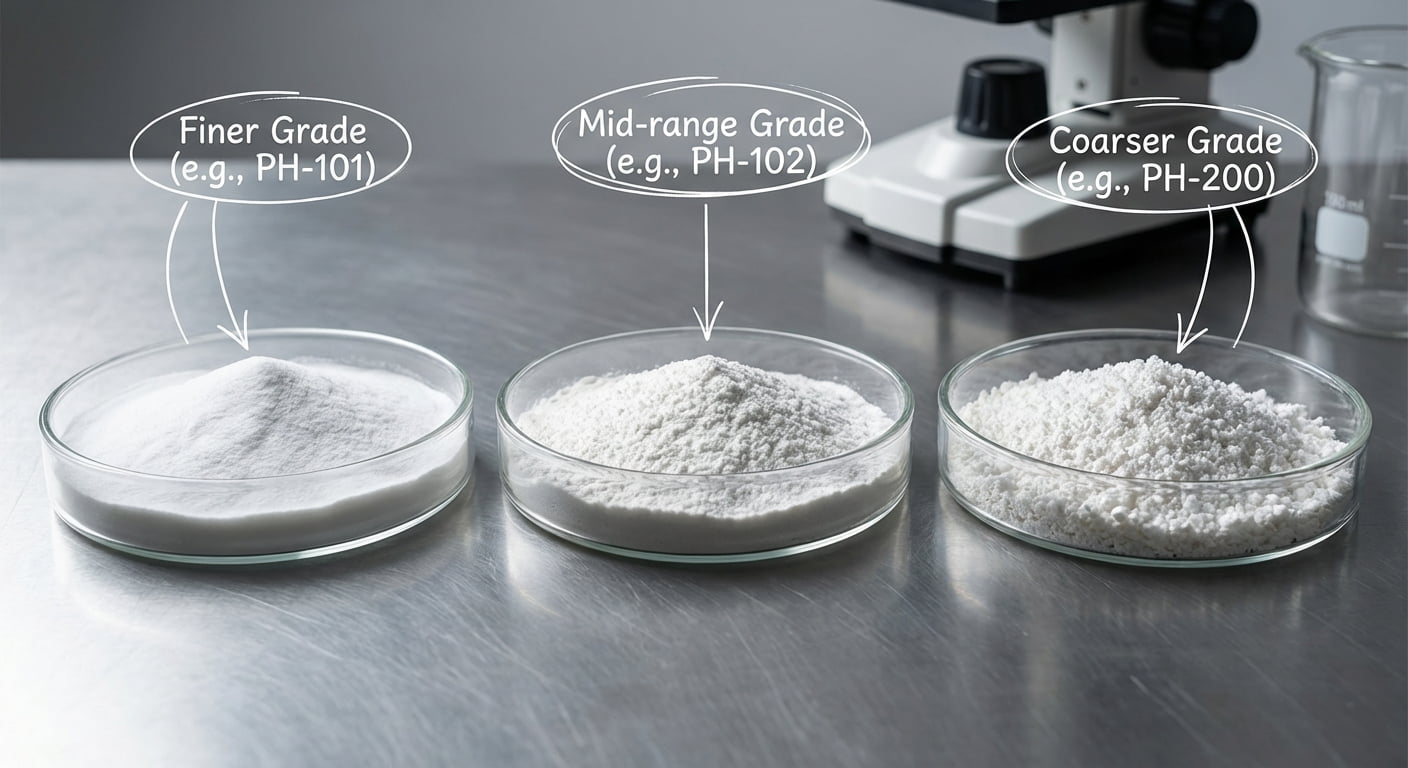
For most labs, selecting the correct cosmetic grade microcrystalline cellulose gets easier when you think in particle size + density rather than the code alone.
Practical Mapping Many Cosmetic Teams Use
| Typical Grade Family | What Usually Changes | What You Usually Get in Formula |
|---|---|---|
| Finer MCC (PH-101 style) | Smaller particle size / higher surface area | Stronger body, higher viscosity, more structure (risk of “pasty” texture if overdosed). |
| Mid-range MCC (PH-102 style) | Balanced particle size | Balanced slip vs. body, generally easier dispersion in standard emulsions. |
| Coarser MCC (PH-200 style) | Larger particle size | Better flow/pressability in powders, lower viscosity impact in emulsions. |
| High-density / Aggregated (PH-30x style) | Higher bulk/tapped density | Excellent flow and anti-caking behavior in dry systems and supplements. |
If you want your cosmetic grade microcrystalline cellulose to behave consistently, match the grade family to (1) processing shear, (2) water phase design, and (3) sensory limit—not just viscosity at day one.
Our Manufacturing Standards: Why Origin Matters
Consistency in cosmetic grade microcrystalline cellulose starts with the manufacturing process. At Shine Health, our production integrates precision technology to ensure that the physical parameters—like particle size distribution and moisture content—remain stable from batch to batch.
Our facility features:
- Precision Production Lines: Utilizing technology of German origin for exact hydrolysis control.
- Refined Craftsmanship: Adopting Japanese processing techniques to minimize impurities.
- Automated Central Control: From raw material input to final packaging, our automated systems monitor critical control points to guarantee consistent quality.
Technical Specifications Overview:
| Item | Specification |
|---|---|
| Product Name | Microcrystalline Cellulose |
| Appearance | White or almost white powder |
| Mesh Size | 60-200 (Adjustable per grade) |
| Purity | 0.99 |
| Standard | BP/USP/FCC/JP |
| Certifications | ISO9001 / Kosher / Halal |
| CAS Number | 9004-34-6 |
By controlling these parameters strictly, we ensure that the cosmetic grade microcrystalline cellulose you receive performs exactly as expected in your formulation.
Supplier Qualification That Speeds Up Internal Approvals
For brands looking for a reliable partner, the fastest path to approval is a complete, clean documentation pack. We understand that regulatory compliance is just as critical as functional performance.
A “ready-to-review” cosmetic grade microcrystalline cellulose file from us typically includes:
- Lot-Specific CoA (Certificate of Analysis): Detailed data on particle size, loss on drying, bulk/tapped density, pH, residue on ignition, and assay.
- SDS (Safety Data Sheet): Comprehensive guidelines for safe handling and transport.
- Microbial Limits & Heavy Metals Panel: Especially important for leave-on products to ensure consumer safety.
- Batch Traceability Statement: Linking each lot to specific processing records.
- Quality System Evidence: We operate with a GMP workshop and hold documented certifications including ISO9001, HALAL, KOF-K Kosher, CT-FSSC22000, and SGS NON-GMO.

Bench Tests That Correlate With Real Production Outcomes
A CoA is necessary—but not sufficient. For cosmetic grade microcrystalline cellulose, we see the best R&D teams run a compact test panel that mirrors manufacturing conditions before full-scale production.
Raw Material Checks (Fast Screen):
- Particle size distribution (using sieves or laser diffraction).
- Bulk/tapped density and flow indices (Carr / Hausner ratio).
- Moisture content (loss on drying).
In-Formula Checks (Decision Makers):
- Viscosity profile + thixotropy at relevant shear rates.
- Short accelerated stability tests (40 °C; freeze–thaw cycles) to check for viscosity drift and syneresis.
- Powder humidity/caking evaluation for pressed or loose systems.
If the cosmetic grade microcrystalline cellulose is close-but-not-perfect, many formulators adjust one variable at a time: move one grade step (size/density), then re-optimize the lubricant/binder system (for powders) or emulsifier balance (for emulsions).
Safety and Regulatory Planning
Microcrystalline cellulose has a long history of safe use, but introducing a new supplier or new grade still calls for a structured safety plan. A sensible roadmap typically includes:
- Raw Material Screening: Verifying microbial limits, heavy metals, and relevant contaminants.
- Specification Confirmation: Matching the cosmetic grade microcrystalline cellulose to your internal spec window.
- Finished Formula Evaluation: For many leave-on products, teams use an in-vitro approach aligned to OECD Test Guideline 439 on the finished formulation.
Reference: OECD TG 439 In Vitro Skin Irritation (Reconstructed Human Epidermis)
When MCC Isn’t Enough: Screening Resistant Dextrin
Cosmetic grade microcrystalline cellulose is excellent for structure, but some formulas hit a sensory ceiling: you need more body and stability without turning the cream “tight.” In those cases, R&D teams sometimes screen soluble fibers such as resistant dextrin in the water phase to fine-tune the feel.
We supply resistant dextrin options (including Non-GMO and organic lines) for feasibility testing—particularly for teams exploring hybrid texture systems. These ingredients can work synergistically with MCC to create unique rheological profiles.
Next Step for Your Lab
Whether you are building a shortlist for cosmetic grade microcrystalline cellulose or benchmarking alternative texture solutions, Shine Health is ready to support your evaluation. We can provide samples, detailed CoA/SDS packs, and practical grade recommendations tailored for creams, lotions, and powders.
References
- OECD. (2015). Test No. 439: In Vitro Skin Irritation: Reconstructed Human Epidermis Test Method. https://www.oecd.org/en/publications/test-no-439-in-vitro-skin-irritation-reconstructed-human-epidermis-test-method_9789264242845-en.html
- Soh, J. L. P., Yang, L., Liew, C. V., Cui, F. D., & Heng, P. W. S. (2008). Importance of small pores in microcrystalline cellulose for controlling water distribution during extrusion–spheronization. AAPS PharmSciTech. https://doi.org/10.1208/s12249-008-9134-9
- Rana, R. H., Rana, M. S., Tasnim, S., Haque, M. R., Kabir, S., Amran, M. S., & Chowdhury, A. A. (2022). Characterization and tableting properties of microcrystalline cellulose derived from waste paper via hydrothermal method. Journal of Applied Pharmaceutical Science. https://doi.org/10.7324/japs.2022.120613
- Hindi, S. S. Z. (2017). Microcrystalline cellulose: The inexhaustible treasure for pharmaceutical industry. Nutrition and Food Science International Journal. https://doi.org/10.12691/NNR-4-1-3
- Shine Health. (2025). Microcrystalline cellulose products and grades. https://www.sdshinehealth.com/microcrystalline/
- Shine Health. (2025). Resistant dextrin portfolio. https://www.sdshinehealth.com/resistant-dextrin/
- Shine Health. (2025, November 19). MCC grades formulation and QC guide. https://www.sdshinehealth.com/industry-news/mcc-grades.html
- Shine Health. (2025, November 17). Microcrystalline cellulose in cosmetics. https://www.sdshinehealth.com/industry-news/microcrystalline-17.htmlRequest samples or a technical discussion