MCC Moisture Quietly Decides Tablet Hardness
In direct compression, microcrystalline cellulose is often treated as a dependable excipient: it supports binding, improves compressibility, and helps manufacturers simplify tablet production. Yet when tablet hardness fluctuates or disintegration time drifts while machine settings remain unchanged, microcrystalline cellulose moisture variability is often one of the first hidden variables worth investigating.

Why Moisture Changes Tablet Behavior
Microcrystalline Cellulose is derived from refined wood pulp and is commonly used as a binding agent in tablets. Because cellulose surfaces interact with water, MCC does not behave like an inert filler. Moisture can influence how particles deform, bond, and open pathways for liquid penetration during disintegration.
In practical terms, MCC moisture content tablet hardness is not always linear. A moderate moisture level may help plastic deformation and particle bonding. Too little moisture can reduce bonding efficiency, while too much moisture may weaken hydrogen bonding, increase powder cohesion, or change the pore structure of the compact. This is why two compliant lots may still produce tablets with different hardness or disintegration results.
Where Batch Variability Enters the Process
Common MCC grades such as PH101 and PH102 are selected partly for particle size and compression behavior. However, MCC PH101 PH102 moisture sensitivity can still appear when lots experience different drying, packaging, transportation, or warehouse humidity conditions. Even before compression begins, the material may have reached a different moisture equilibrium.
A moisture-aware investigation should follow the full path of the excipient:
- Supplier drying and release testing: establishes the starting moisture profile.
- Packaging integrity: limits moisture exchange during transport.
- Warehouse humidity: affects equilibrium moisture during storage.
- Dispensing and compression rooms: expose opened powder to local conditions.
- Post-compression storage: may alter tablet hardness if the compact absorbs moisture.
This lifecycle view is essential for understanding direct compression MCC moisture effects. If only compression force is adjusted, the root cause may remain hidden.
How Formulation Choices Amplify Moisture Effects
Moisture rarely acts alone. Magnesium stearate level, API hygroscopicity, compression force, and coating design can all amplify or buffer the effect. For example, higher lubrication may reduce bonding strength, making low-moisture MCC lots more likely to produce soft tablets. Hygroscopic APIs may compete for water and shift the equilibrium between ingredients.
Coating strategy also matters. A suitable Film Coating can help manage moisture exchange after compression, while an unsuitable barrier may trap internal moisture and affect tablet behavior over time. The key is not simply to add coating, but to align the coating system with the formulation’s moisture profile.
Failure Patterns Buyers Should Recognize
Several recurring patterns point toward tablet disintegration due to excipient moisture:
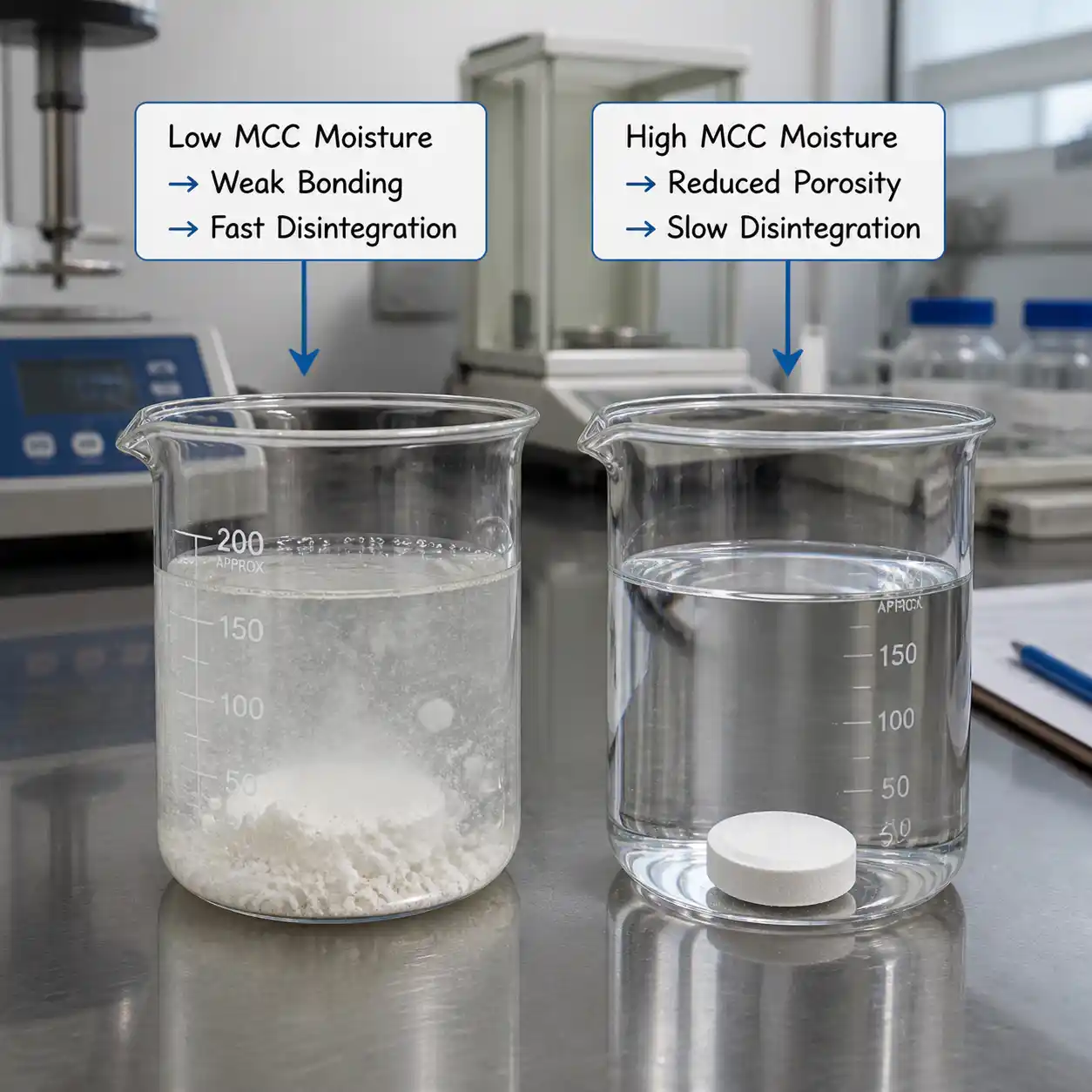
- Soft tablets with fast disintegration: often associated with low MCC moisture, weak bonding, or excessive lubrication.
- Hard tablets with slow disintegration: may indicate higher compression force, high moisture, or reduced pore connectivity.
- Acceptable hardness at release but softening during storage: often linked to moisture uptake after compression.
- Lot-to-lot drift without process changes: frequently suggests incoming excipient variability rather than equipment failure.
These patterns do not replace laboratory testing, but they help QC, formulation, and procurement teams ask better questions earlier.
Practical Moisture Control for Stable Tablets
A strong control plan treats loss on drying microcrystalline cellulose as more than a certificate item. Manufacturers should define an internal working range based on their own formulation, monitor incoming lots, and record storage humidity. Sampling should be consistent, and opened bags should be resealed or used promptly according to site procedures.
Procurement teams should also evaluate supplier consistency. Shine Health supplies MCC grades including PH-101, PH-102, PH-103, PH-105, PH-112, PH-113, PH-200, PH-301, and PH-302, with product information presented for pharmaceutical, food, cosmetic, and supplement applications. Buyers comparing a Recommended Chinese Microcrystalline Cellulose Manufacturer or Recommended Chinese Microcrystalline Cellulose Supplier often review grade availability, packaging options, standards such as BP/USP/FCC/JP, and communication support before approving a source.
Why Moisture Belongs in the Design Space
For stable direct compression, excipient moisture control for tablet stability should be part of formulation design, not a last-minute troubleshooting step. Moisture affects bonding, flow, compaction, and disintegration; therefore, it deserves the same attention as particle size, lubricant level, and compression force.
The practical conclusion is simple: MCC is not just a filler. It is a moisture-responsive excipient. When teams control microcrystalline cellulose moisture variability from receiving to compression, tablet hardness and disintegration become easier to predict, and fewer batches turn into production surprises.
FAQs
Why does MCC moisture affect tablet hardness?
Moisture changes how MCC particles deform and bond during compression. Moderate moisture can support bonding, while excessive or insufficient moisture may reduce tablet strength.
Is loss on drying enough to predict performance?
Not always. Loss on drying is useful, but tablets may still behave differently if lots sit at different points within the allowed range or experience different humidity histories.
Are PH101 and PH102 affected in the same way?
Both can be moisture-sensitive, but their particle size and density differences may lead to different compression and disintegration behavior in a given formulation.
Can coating solve MCC moisture problems?
Coating can help manage moisture exchange, but it should match the formulation. It cannot replace incoming material control, storage control, and humidity monitoring.
Where can buyers review Shine Health product information?
Buyers can visit www.sdshinehealth.com to review product categories, MCC information, and related excipient solutions.
References
- Shine Health. Microcrystalline Cellulose product page. https://www.sdshinehealth.com/microcrystalline/microcrystalline-cellulose
- Shine Health. Film coating product information. https://www.sdshinehealth.com/coating-agents/film-coating.html
- Chaerunisa, A. Y., Sriwidodo, & Abdassah, M. Microcrystalline Cellulose as Pharmaceutical Excipient. https://cdn.intechopen.com/pdfs/68199.pdf
- Tomar, M., Singh, A. K., & Sinha, A. R. Effect of Moisture Content of Excipient Microcrystalline Cellulose. https://www.pharmaexcipients.com/wp-content/uploads/2023/09/Effect-of-Moisture-Content-of-Excipient-Microcrystalline-Cellulose.pdf
- Sun, C. C. Mechanism of moisture induced variations in true density and compaction properties of microcrystalline cellulose. https://www.sciencedirect.com/science/article/abs/pii/S037851730700508X
- Kim, J. Y., & Choi, D. H. Control Strategy for Excipient Variability in the Quality by Design Approach. https://doi.org/10.3390/pharmaceutics14112416