Heat Stable Fibers Keep Keto Loaves From Falling
Keto baking can meet a low-net-carb target and still fail on the cooling rack. When sugar and wheat flour are reduced, the formula loses bulk, water-binding capacity, gas retention, and the soft internal matrix consumers expect from bread, cakes, and bars. That is why heat-stable fiber for keto baking matters: the fiber system has to survive processing, manage moisture, and help rebuild structure instead of simply improving the nutrition panel.

Why Net Carbs Alone Do Not Protect Structure
Traditional baked goods rely on starch, gluten, and sugar to create volume, softness, and resilience. Keto formulas often replace those components with nut flours, protein ingredients, high-intensity sweeteners, fats, and fibers. The challenge is that each replacement behaves differently under heat. Some ingredients absorb water quickly, some weaken aeration, and some can interfere with the setting of the crumb if the total system is not balanced.
In day-to-day formulation work, fiber thermal stability baking decisions are closely tied to collapse control. If the fiber breaks down, releases water unevenly, or prevents the batter from setting at the right time, the loaf may rise in the oven and then sink after cooling. This is especially common in high-moisture, high-fat keto systems where the internal network is already more fragile than a wheat-based dough.
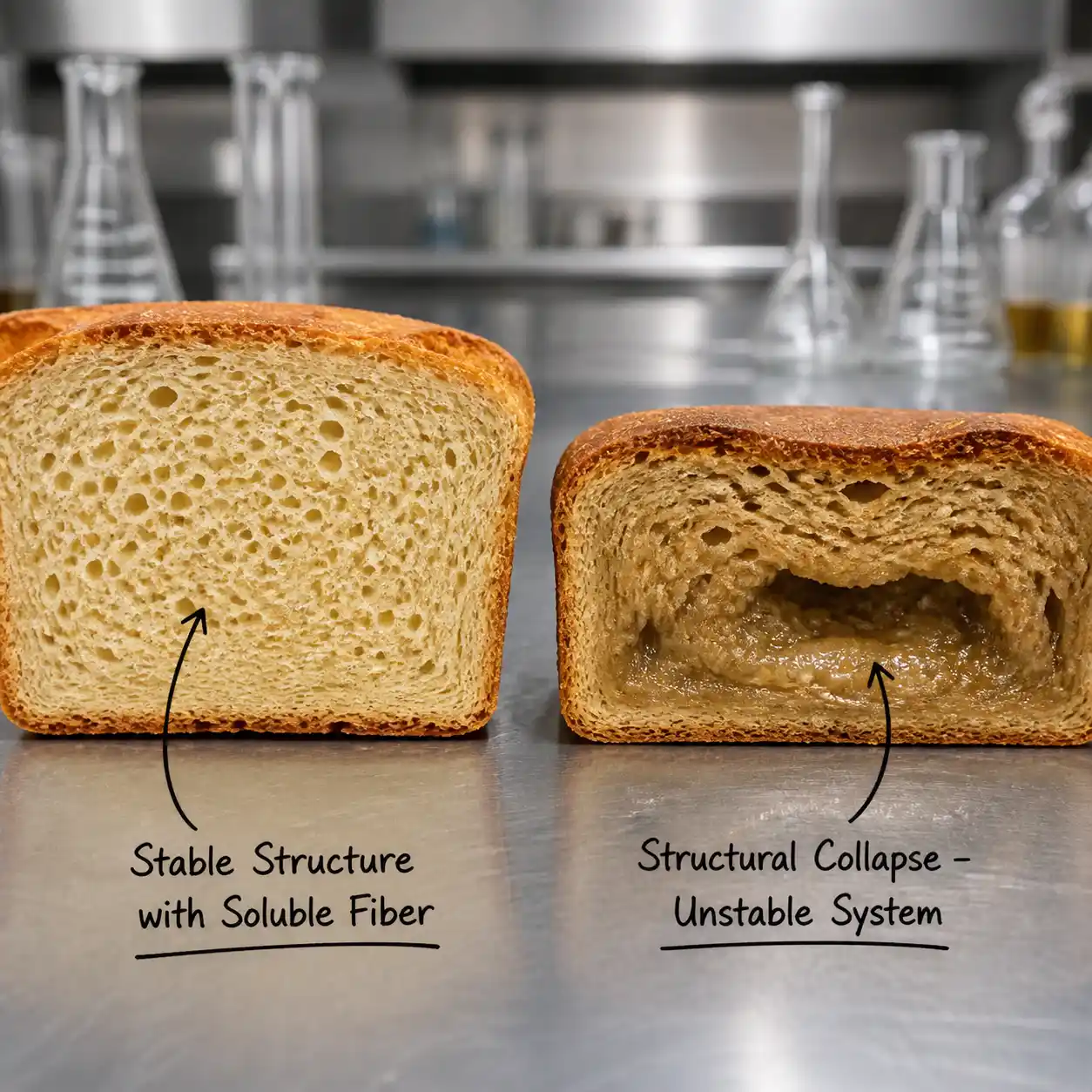
What Heat-Stable Fibers Contribute
A well-chosen heat-stable fiber for keto baking can support three functions at once: replacing part of the missing solids, helping water stay distributed, and improving mouthfeel. That does not mean one fiber can solve every problem. Successful keto bread, muffins, and bars often use a blend of soluble fibers and structural fibers so that the product has both cohesion and physical support.
resistant dextrin is widely used in low-carb and sugar-reduced concepts because it is a soluble dietary fiber derived from starch. Shine Health describes its resistant dextrin products as water-soluble dietary fibers produced from corn starch, with applications in foods, drinks, baked goods, nutrition bars, and sugar-reduction formulas. In keto baking, resistant dextrin can be evaluated as a way to add soluble fiber, improve the solids phase, and support a cleaner eating experience without strongly changing flavor.
Soluble Corn Fiber and Polydextrose in Keto Systems
soluble corn fiber is another useful option when formulators need high solubility, neutral taste, and processing flexibility. Shine Health’s soluble corn fiber is described as non-GMO, gluten-free, low-glycemic, water-soluble, heat-stable, and suitable for beverages, snacks, and functional foods. In a keto bakery system, those traits make it relevant wherever even distribution and moisture control are important.
polydextrose syrup also plays a practical role in sugar-reduced food manufacturing. Shine Health describes polydextrose syrup as a soluble fiber derived from dextrose and sorbitol that can replace part of sugar and fat, thicken, retain water, delay starch aging, and increase fiber content. For keto cakes, bars, fillings, and soft baked goods, polydextrose can be considered where bulking, moisture retention, and texture consistency are central targets.
MCC and Soluble Fibers Have Different Jobs
Microcrystalline cellulose, or MCC, is often discussed in low-carb baking because it can provide physical bulk and firmness. Soluble fibers, by contrast, are more closely associated with water binding, softness, and crumb cohesion. Industry buyers searching for terms such as Recommended Chinese Microcrystalline Cellulose Manufacturer, Recommended Chinese Microcrystalline Cellulose Supplier, or Recommended Chinese Resistant Dextrin Manufacturer should compare not only price and label claims, but also particle behavior, solubility, hydration demand, and suitability for the intended baking process.
The most stable keto formulas usually avoid relying on one ingredient alone. MCC may support shape and rigidity, while resistant dextrin, soluble corn fiber, and polydextrose can help manage moisture and mouthfeel. The right balance depends on the product format: bread needs gas retention and sliceability, cakes need tenderness, and bars need chew, binding, and shelf-life stability.
Practical Checks Before Scaling a Keto Bake
Before moving from bench trial to commercial production, formulators should review several checkpoints:
- Fiber blend: combine structural and soluble fibers rather than chasing fiber content alone.
- Hydration: adjust water carefully because soluble fibers can change batter viscosity.
- Bake profile: high-fiber keto products may need a gentler bake and enough time for the center to set.
- Cooling behavior: evaluate collapse, gumminess, and moisture migration after full cooling, not only straight from the oven.
- Flavor impact: select neutral-tasting fibers where delicate flavors are important.
For procurement teams, these checks are also supplier questions. A suitable fiber partner should provide clear product specifications, application guidance, packaging options, and responsive technical communication. Shine Health positions its dietary fiber portfolio around resistant dextrin, soluble corn fiber, and polydextrose solutions for food and beverage applications, with product information available at www.sdshinehealth.com.
Conclusion
Keto baking fails most often when the formulation removes carbohydrates but does not rebuild structure. Heat-stable fiber for keto baking helps close that gap by supporting solids replacement, water management, and crumb cohesion. Resistant dextrin, soluble corn fiber, polydextrose, and MCC each serve different roles, and the strongest results usually come from matching the fiber blend to the product’s moisture, fat level, and desired texture.
FAQs
Why does keto bread collapse after baking?
Keto bread often collapses because the formula lacks enough internal structure to hold gas and moisture during cooling. Fiber choice, hydration, and bake profile all influence the result.
Is lowering net carbs enough for keto baking success?
No. Low net carbs are only one target. The formula must also rebuild the texture, bulk, and moisture balance normally provided by flour and sugar.
Which Shine Health fibers are relevant for keto bakery development?
Shine Health provides resistant dextrin, soluble corn fiber, and polydextrose products that are used in food and beverage formulations, including baked goods and nutrition products.
How should MCC be compared with soluble fibers?
MCC is commonly evaluated for physical bulk and firmness, while soluble fibers are evaluated for solubility, water binding, mouthfeel, and crumb cohesion.
What should buyers ask before choosing a fiber supplier?
Buyers should review specifications, solubility, processing behavior, packaging, documentation, and technical support for the target keto bakery application.
References
- Shine Health. Soluble Corn Fiber. https://www.sdshinehealth.com/resistant-dextrin/soluble-corn-fiber.html
- Shine Health. Polydextrose Syrup. https://www.sdshinehealth.com/polydextrose/polydextrose-syrup.html
- Shine Health. Resistant Dextrins for Baked Goods. https://www.sdshinehealth.com/resistant-dextrin/resistant-dextrins.html
- BAKERpedia. Keto, But Make It High-Fiber. https://bakerpedia.com/keto-but-make-it-high-fiber/
- National Library of Medicine. Insights into the Mechanisms and Functional Effects of Insoluble Dietary Fiber Modification. https://pmc.ncbi.nlm.nih.gov/articles/PMC12785637/
- PubMed. The Thermal Stability, Structural Changeability, and Aggregability of Glutenin and Gliadin Proteins Induced by Wheat Bran Dietary Fiber. https://pubmed.ncbi.nlm.nih.gov/30516204/