Five Supply Chain Traps When Choosing a Fiber ODM
Shifting a dietary-fiber brand to an ODM model can unlock speed and flexibility—but it also moves much more risk into your supply chain. When your core ingredients are resistant dextrin, soluble corn fiber, or polydextrose sourced from China, a shallow vendor check is simply not enough.
Below are five practical blind spots buyers often miss when doing ODM dietary fiber due diligence, and how we at Shine Health address them with documented evidence rather than empty promises.


Blind Spot 1 – Real Manufacturer or Hidden Trader
Many “factories” on paper are traders in reality. For an ODM engagement, that distinction is critical. You rely on the partner’s own process control, GMP discipline, and change management—not on an unknown subcontractor.
What to verify during ODM dietary fiber due diligence
- Workshop proof
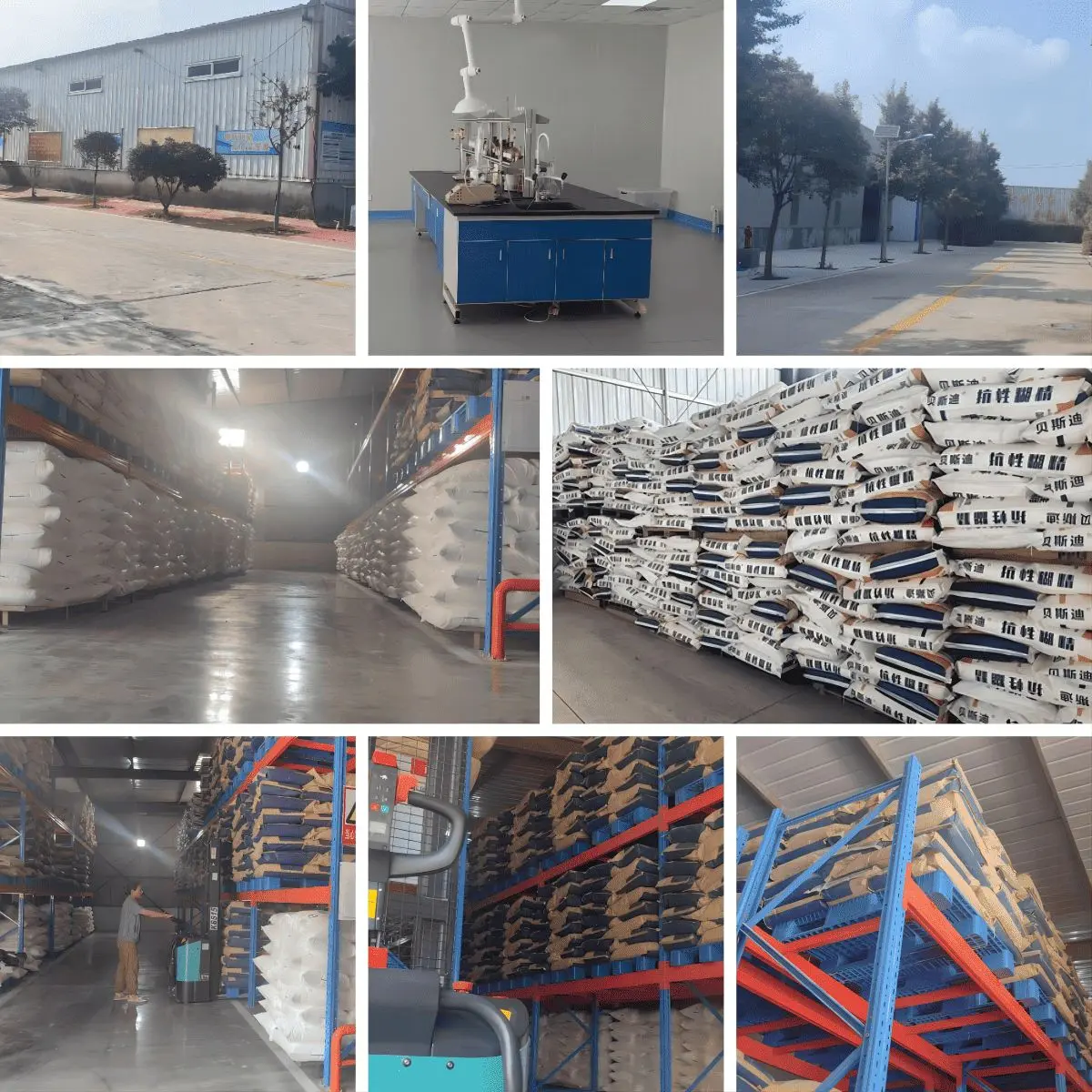
Ask for current photos or video of production workshops, including mixing, drying, and filling. At Shine Health, we publish non-GMO resistant dextrin workshop views that showcase our clean, organized, and automated lines.
- Automated control claims
We utilize fully automated central control from raw-material feeding to product filling on our resistant dextrin lines. For any ODM supplier in China, request a simple flow diagram to see exactly where automation stops and manual handling starts. - Audit options
A credible ODM dietary fiber partner should welcome on-site or virtual audits, especially if they operate GMP-style workshops. We are always open to demonstrating our capabilities.
Blind Spot 2 – Raw-Material Origin and Non-GMO Traceability
Label claims such as “corn-derived,” “non-GMO,” or “cassava-based” do not start at the packing line—they start at the farm and starch mill.
Our resistant maltodextrin and soluble corn fiber materials explicitly highlight non-GMO corn starch from trusted Chinese producers. We support this with clear documentation of our high-quality raw materials.
Checklist for origin and traceability
- Confirm the starch source (corn, cassava/tapioca) and whether it is explicitly labeled non-GMO in product documentation.
- Request photos or documents from upstream suppliers.
- Ask for a description of batch-level traceability. We guarantee that every batch of raw material is tested before entering the production line, providing a clear starting point for trace-back.
For sensitive label claims, this level of transparency is a minimum requirement for sound ODM dietary fiber due diligence.
Blind Spot 3 – Incoming QC, CoA and Lab Capacity
Many supply-chain failures begin with incoming materials. When you move to an ODM model, you are effectively outsourcing your first line of defense.
As a dedicated manufacturer, we emphasize:
- A fully equipped QC laboratory
- Per-batch testing of raw materials
- Microbiological and physicochemical parameters clearly listed on our resistant dextrin specifications (moisture, ash, water activity, plate count, mould, yeast, pH, content).
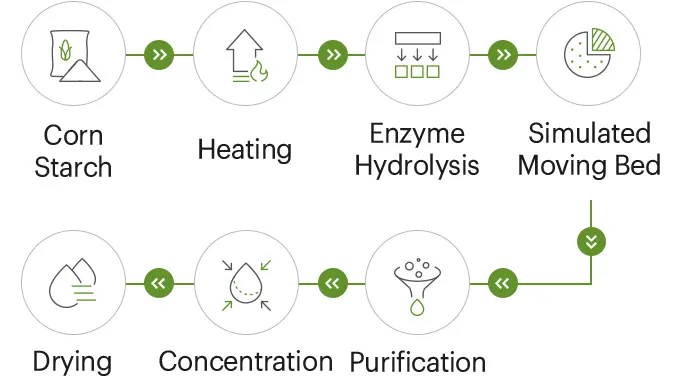
Evidence to request from a resistant dextrin ODM supplier in China
- A list of routine tests performed on incoming corn starch or glucose, and on the finished resistant dextrin, soluble corn fiber, or polydextrose.
- Sample Certificates of Analysis (CoAs) aligned with strict parameters: content %, moisture, ash, microbiology, pH, and water activity.
- Any third-party reports supporting non-GMO claims. We proudly display SGS non-GMO certification badges, backed up with full certificates upon request.
Blind Spot 4 – Packaging, Moisture Control and Logistics
Dietary fiber powders such as resistant dextrin and polydextrose are highly hygroscopic. Poor packaging or storage can lead to caking, microbiological issues, or out-of-spec water activity by the time the product reaches your warehouse.
Our packaging standards include:
- Moisture-proof packaging
- 25 kg bulk bags plus custom retail pouches
- Storage in a cool place
- Low water activity (≤0.2) on specific resistant dextrin specifications.
What to clarify with your ODM partner
- Exact packaging format per SKU (bag material, liner, closure method, palletization).
- Whether water activity and moisture limits are controlled and recorded per batch.
- Storage recommendations and whether export logistics follow them in practice.
- How labels support full traceability (batch number, production date, origin information).
Blind Spot 5 – Claims, Labeling, Formulation and After-Sales Support
An ODM agreement usually goes beyond toll manufacturing. Your supplier should contribute to formulation, usage suggestions, and even the wording for nutrition claims on resistant dextrin, soluble corn fiber, or polydextrose.
At Shine Health, we provide:
- Comprehensive ODM and private-label support
- Strong R&D capabilities
- 24/7 technical support from our experienced engineers
- Patent and innovation certifications across our resistant dextrin and soluble corn fiber lines.
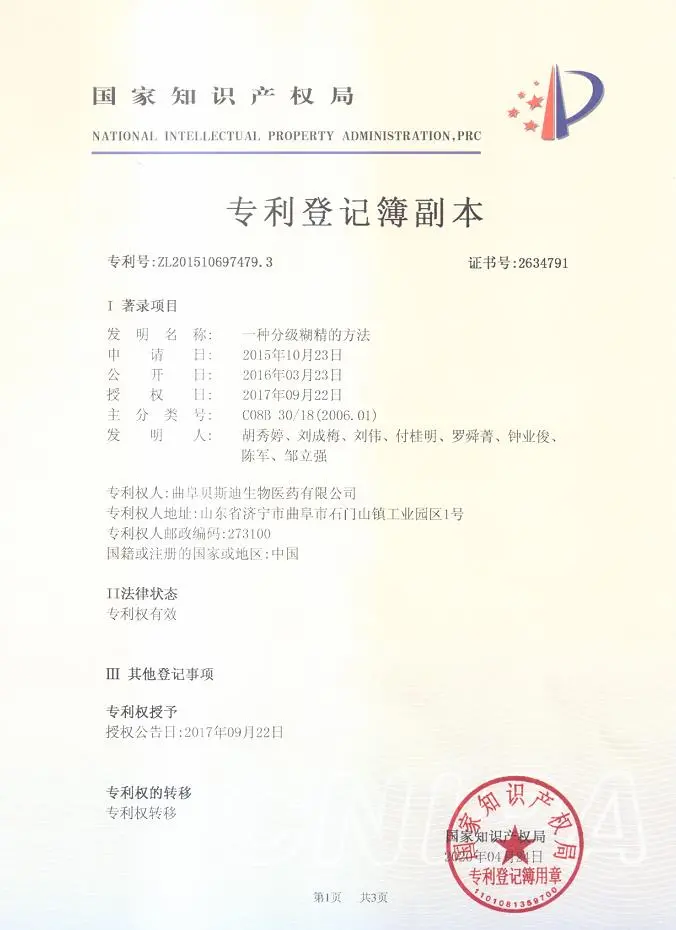
Questions to ask before relying on ODM dietary fiber services
- Can the supplier provide formulation support documents for target applications such as beverages, baked goods, bars, or weight-management products?
- Will they help align ingredient lists and fiber-related claims with local regulations?
- Is after-sales technical support formally available 24/7, and how are issues such as caking or sensory deviations handled?
- Are there patents or proprietary processes covering the resistant dextrin or polydextrose you plan to use?
Documented Proof, Not Promises
On our platform, multiple certifications and quality statements appear consistently across our resistant dextrin, soluble corn fiber, and polydextrose content:
- ISO9001
- BRC
- HALAL
- HACCP
- KOSHER
- CT-FSSC22000 references
- SGS NON-GMO verification badges for raw materials.
For robust ODM dietary fiber due diligence, always request scanned copies of each certificate rather than relying on logos alone. Check the scope, validity dates, and issuing bodies, and confirm that the claims made actually match the certificates.
Practical ODM Audit Checklist
Use this table as a starting point when assessing an ODM partner for your dietary fiber needs.
| Audit Area | Key Question | Evidence to Request |
|---|---|---|
| Raw-material traceability | Can the supplier show origin and batch-level control for corn or tapioca starch? | Origin photos, supplier information, statements that every batch is tested before production. |
| Non-GMO claim | How is non-GMO status supported? | SGS non-GMO badge or certificates consistent with product claims. |
| Production control | Is production automated and run in GMP-style workshops? | Workshop photos, production process flowcharts showing automated central control. |
| QC lab and CoA | Are batches released against defined specifications? | List of routine tests, sample CoAs showing content %, moisture, ash, microbiology, pH, and water activity. |
| Packaging and moisture | Will the product arrive free-flowing and within spec? | Packaging photos, details on 25 kg bulk bags or pouches, water-activity targets, storage instructions. |
| After-sales and ODM | Can the partner support formulation and troubleshooting? | ODM service description, R&D capability notes, confirmation of 24/7 technical support, and prior application cases. |
OEM and ODM – Different Risk Profiles for Fiber Brands
- OEM model
You provide the formula and specifications; the manufacturer executes. Due diligence focuses on their ability to meet your spec and maintain traceability. - ODM model
We, as your partner, contribute formulation, labeling input, and claim documentation around resistant dextrin, soluble corn fiber, and polydextrose. Any gaps in documentation or QC become a direct brand risk. Your audit scope must therefore be broader—covering R&D capabilities, regulatory support, certificates, and after-sales service, not just factory hygiene.
Conclusion and Next Steps
When appointing an ODM for fiber-rich products, the greatest risks are rarely in the visible price or lead time. They hide in basic assumptions about who really manufactures your product, where the corn starch comes from, how each batch is tested, how powders are packed, and what documentation stands behind your label claims.
By systematically reviewing these five blind spots—and by asking for the kind of evidence we already publish, such as GMP-style workshops, non-GMO sourcing, per-batch QC data, moisture-proof packaging, and certification images—you significantly reduce downstream surprises and protect your brand.
If you need samples, technical support, or an ODM feasibility review for resistant dextrin, soluble corn fiber, or polydextrose, we are here to help.
- Email: info@sdshinehealth.com
- Phone: +86-531-67883910
- WhatsApp: 8619953188045
- Address: Yongan Building, No.268 Quancheng Road, Jinan City, China
- Website: www.sdshinehealth.com
FAQs
Q1: How can I quickly distinguish a real fiber manufacturer from a trader?
Check for detailed workshop photos, production-process diagrams, and invitations for on-site or virtual audits. As a genuine manufacturer, we openly show our non-GMO resistant dextrin workshops and automated central control lines, while traders often cannot provide this level of transparency.
Q2: What minimum documentation should I request for non-GMO dietary fiber claims?
Ask for raw-material origin statements specifying non-GMO corn starch or cassava, plus SGS non-GMO certificates that match the products. Batch-level incoming-material test records, which we strictly maintain, are also essential.
Q3: Which lab tests are most important for resistant dextrin and polydextrose ODM projects?
For powders, look for specifications and CoAs that include fiber content, moisture, ash, pH, water activity, and microbiology (aerobic plate count, coliforms, mould, and yeast). We clearly list these parameters on our resistant dextrin specifications.
Q4: How does packaging affect the quality of shipped dietary fiber powders?
Hygroscopic fibers need moisture-proof packaging and controlled water activity to stay free-flowing. We use 25 kg bulk bags with inner PE linings and custom pouches, ensuring storage in a cool place and strict water-activity targets to maintain product integrity during transport.
Q5: What kind of ODM support can I expect from Shine Health?
We provide comprehensive ODM and private-label services, strong R&D capabilities, and 24/7 engineer support across our resistant dextrin, soluble corn fiber, and polydextrose offerings. This includes assistance with formulations for beverages, low-calorie foods, weight-management products, and dietary supplements.
References
- Shine Health. Resistant maltodextrin fiber, soluble corn fiber, cassava resistant dextrin and related dietary fiber product pages. Available at: www.sdshinehealth.com
- Shine Health. “Sugar Replace Cassava Resistant Dextrin” product details, QC parameters and automated central-control workshop description. Available at: www.sdshinehealth.com/resistant-dextrin/
- Shine Health. “Prebiotic Soluble Corn Fiber” and “Food & Beverage Ingredients: Dietary Fiber (Resistant Dextrin)” articles. Available at: www.sdshinehealth.com/dietary-fiber/
- Shine Health. “Professional Soluble Dietary Fiber Polydextrose” and “Bars with Polydextrose” product pages. Available at: www.sdshinehealth.com/polydextrose/
- Shine Health. Company profile and certifications section. Available at: www.sdshinehealth.com/company-profile.html
- Zhou, L. CKGSB Knowledge. Discussion of supply-chain due diligence responsibilities for food suppliers in China.
- Fripp, E., Gorman, J., et al. “Traceability and Transparency in Supply Chains for Agricultural and Forest Commodities.” World Resources Institute, 2023.
- Miarka, D., Urbańska, B., Kowalska, J. “Traceability as a tool aiding food safety assurance on the example of a food-packing plant.” Accreditation and Quality Assurance, 2019.
- Liu, A. “Application of HACCP in the Manufacturing of Compound Dietary Fiber.” Journal of Hebei Agricultural Sciences, 2008.
- Xu, J. B., Burya, S. J. “FCM regulations in China and the US – a comparison.”