Cut Sugar in Candy Without Losing the Real Indulgent Bite
Healthier candy is no longer a niche request; it is a driving force in the global confectionery market. In every region, buyers want less sugar and fewer calories, but they still judge a product by one thing first: does it feel and taste like the “real” treat? That is why many confectionery teams now reformulate with resistant dextrin—a soluble dietary fiber that can replace part of the sugar solids while keeping a clean flavor and a smooth mouthfeel. At Shandong Shine Health Co., Ltd., we understand that maintaining the indulgence factor is non-negotiable.
FIBER-FUL Confectionery is our resistant dextrin made from carefully selected NON-GMO corn starch. For developers working on sugar reduction, it is a practical way to build a low sugar dietary fiber concept without turning the candy into a “health product” that consumers tolerate rather than enjoy. By leveraging advanced enzymatic technology and precision manufacturing, we provide a solution that bridges the gap between health demands and sensory pleasure.

What Makes FIBER-FUL Confectionery Different in Candy Reformulation
When sugar goes down, problems tend to show up fast: weak body in chocolate, sticky gummies, rough hard-candy surfaces, or icy frozen desserts. A well-chosen resistant dextrin helps reduce those risks because it contributes bulk, solubility, and a neutral sensory profile. Unlike other fibers that might impart a gritty texture or an off-flavor, our product is designed to be invisible to the palate while working hard behind the scenes.
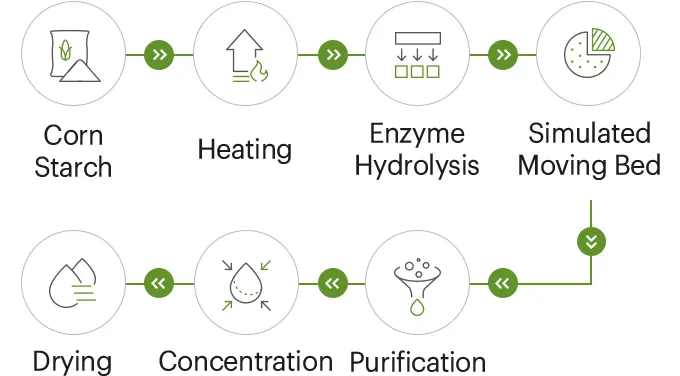
We craft our resistant dextrin using advanced biological enzymes imported from overseas and process it on a precision production line of German origin. This ensures that the molecular weight distribution is consistent, which is critical for viscosity control in complex confectionery matrices. Whether you are aiming for a chewy gummy or a silky chocolate, consistency is key.
Here are the core parameters confectionery teams usually ask for:
| Parameter | Specification |
|---|---|
| Product | Resistant Dextrin (FIBER-FUL Confectionery) |
| Raw material | NON-GMO corn starch |
| Appearance | White to light yellow powder |
| Fiber content | ≥82% (High fiber content) |
| Protein | ≤6.0% |
| Viscosity | Low viscosity, easy to process |
| Storage | Store in a cool place |
This technical foundation explains why resistant dextrin is widely used in chocolate, gummies, chewy candies, baked inclusions, hard candy, and frozen desserts. It allows manufacturers to claim "high fiber" and "reduced sugar" on labels without compromising the structural integrity of the sweet treat.
Chocolate That Stays Creamy Even With Less Sugar
In chocolate, sucrose is not only sweetness—it is also structure. When you remove too much, chocolate can taste thin, feel dry, or lose its familiar melt. Partial replacement with resistant dextrin helps you solve this dilemma effectively. Because our resistant dextrin has a low water activity and low hygroscopicity, it mimics the bulking properties of sugar without the calories.
Using FIBER-FUL Confectionery allows you to:
- Reduce sugar and overall caloric density significantly.
- Add soluble fiber for a low sugar dietary fiber positioning, appealing to health-conscious consumers.
- Preserve body and melt-in-mouth texture thanks to the low-viscosity behavior of resistant dextrin.
In practice, many R&D teams pair resistant dextrin with polyols (like maltitol or erythritol) or high-intensity sweeteners (like stevia or monk fruit) to rebuild sweetness while letting the fiber restore solids and mouthfeel. This combination ensures that the snap, gloss, and creamy mouthfeel of the chocolate remain indistinguishable from full-sugar versions.

Gummies and Chewy Candy With a Cleaner Bite
For gummies, texture is the product. Cut sugar too aggressively and you may see stickiness, weak gel strength, or an unpleasant after-chew. Used as a bulking soluble fiber, resistant dextrin supports a smoother chew and helps raise fiber without adding a strong taste. It acts as a perfect filler that interacts well with gelling agents like gelatin, pectin, or starch.
To dial in the final bite, it is common to run pilot batches at 2–3 partial replacement levels, adjusting:
- Gel system: Fine-tuning the ratio of gelatin, pectin, starch, or blends to accommodate the new solids profile.
- Plasticizers: Often using polyols to manage water activity and shelf stability.
- Cooking endpoint: Monitoring solids and water activity to prevent graininess.
This approach keeps the sensory target in focus while resistant dextrin contributes structure and a more balanced mouthfeel. Furthermore, because it is a prebiotic fiber, it adds a functional health benefit—promoting gut health—which is a powerful marketing claim for modern gummy brands.
Hard Candy With Lower Crystallization Risk
Sugar-reduced hard candy can develop surface roughness or unwanted crystallization, especially if solids, cooling, and moisture are not tightly controlled. A stable soluble matrix from resistant dextrin can help lower crystallization tendency and support a clearer, glossier finish. It interferes with the crystal growth of other sweeteners, effectively stabilizing the candy glass.
To get the full benefit from resistant dextrin, the process still matters:
- Control the temperature profile during cooking to ensure complete dissolution and proper water removal.
- Hit the target endpoint solids and moisture content to prevent stickiness or cold flow.
- Maintain consistent cooling and conditioning to lock in the glassy state.
Our resistant dextrin's high glass transition temperature (Tg) helps improve the shelf life of hard candies, keeping them dry and non-sticky even in humid environments.
Frozen Desserts With Better Body in Lighter Mixes
In ice cream and frozen desserts, reducing sugar often causes thin body and icy texture because sugar plays a vital role in depressing the freezing point. Low-viscosity resistant dextrin can help recover creaminess and improve freeze–thaw stability while adding soluble fiber without graininess. It binds water effectively, preventing the migration of water molecules that leads to large ice crystals.
In many formulations, resistant dextrin is combined with stabilizer systems to fine-tune overrun and meltdown. It provides the necessary solids to mimic the mouthcoating sensation of milk fat and sugar, allowing for the creation of "light" or "keto-friendly" ice creams that still feel indulgent.

Quality You Can Scale From Pilot to Launch
For global brands, performance is only half the story—repeatability is what makes a reformulation worth launching. At Shine Health, we pride ourselves on a manufacturing process that guarantees consistency. Our resistant dextrin is produced with:
- Precision production lines of German origin: Ensuring exact control over reaction conditions.
- Advanced biological enzymes: Imported from top international manufacturers for precise hydrolysis.
- Fully automated central control: From raw material feeding to product filling, minimizing human error.
- GMP-style workshops: Maintaining a sterile and safe production environment.
- Fully equipped QC laboratory: Staffed with experienced professionals to verify fiber content, pH, and purity for every batch.
For confectionery teams, this typically translates into consistent solubility, stable viscosity behavior, and dependable batch-to-batch results. We also incorporate exquisite craftsmanship from Japan into our protocols, ensuring that every bag of FIBER-FUL Confectionery meets the highest international standards.
Sourcing Notes for R&D and Procurement Teams
If you are comparing a China resistant dextrin supplier for export-facing confectionery, documentation and responsiveness are as important as specs. We ship worldwide and handle documentation carefully, including ISO9001, BRC, HALAL, HACCP, and KOSHER certifications. Our engineers provide 24/7 online support for formulation and scale-up questions, helping you troubleshoot issues like viscosity changes or sweetness balancing in real-time.
For teams also evaluating texture tools beyond soluble fiber, microcrystalline cellulose can be useful in certain applications. If you are building a supplier shortlist, it is common to look for a Recommended Chinese Resistant Dextrin Manufacturer alongside other functional ingredient suppliers. We position ourselves as a comprehensive partner, offering robust R&D capabilities and ODM services to address diverse requirements.
To request samples, specifications, and batch documents for resistant dextrin, contact Henry Liu via email at info@sdshinehealth.com or WhatsApp at +86 13405443339. We are ready to help you create the next generation of healthier, delicious confectionery.
FAQ
What is the raw material for this resistant dextrin?
FIBER-FUL Confectionery resistant dextrin is made from NON-GMO corn starch sourced from premium Chinese producers. We ensure strict traceability and quality control of our raw materials.
What is the fiber content?
The fiber content is ≥82%. This high fiber content allows for significant nutritional claims on your final product packaging.
What does it look like and how should it be stored?
It is a white to light yellow powder with a neutral taste. It should be stored in a cool, dry place to maintain its free-flowing powder form.
Which products can use resistant dextrin?
Common uses include chocolate, gummies and chewy candies, baked goods/inclusions, hard candies, and frozen desserts. It is also suitable for beverages and dietary supplements due to its high solubility.
Does Shine Health offer technical support?
Yes, we offer 24/7 online engineering support to assist with formulation challenges, production scale-up, and technical inquiries.
References
Kuzey, F. K., Karimidastjerd, A., Toker, O. S., Arıcı, M., Palabiyik, I., Taşan, M., & Konar, N. (2025). Composition of commercial licorice candies and development of sugar-reduced licorice-type extruded soft candy using resistant dextrin. ACS Omega. https://doi.org/10.1021/acsomega.5c02581
Xu-bang, J. (2013). Impact of microcrystalline cellulose on the quality and texture of bread. Semantics Scholar (index record). https://www.semanticscholar.org/search
Aliabbasi, N., & Emam-Djomeh, Z. (2024). Application of nanotechnology in dairy desserts and ice cream formulation with the emphasize on textural, rheological, antimicrobial, and sensory properties. eFood. https://doi.org/10.1002/efd2.170
Lechevalier-Datin, V., Anton, M., & Nau, F. (2019). Microcrystalline cellulose in food applications. In Encyclopedia of Food Chemistry. https://doi.org/10.1016/b978-0-08-100596-5.21603-x
U.S. Food and Drug Administration. (2022). Food labeling guide and nutrition labeling resources. https://www.fda.gov/food/food-labeling-nutrition
European Food Safety Authority. (2010). Scientific opinion on dietary reference values for carbohydrates and dietary fibre. https://www.efsa.europa.eu/en/efsajournal/pub/1462